
Executive Summary
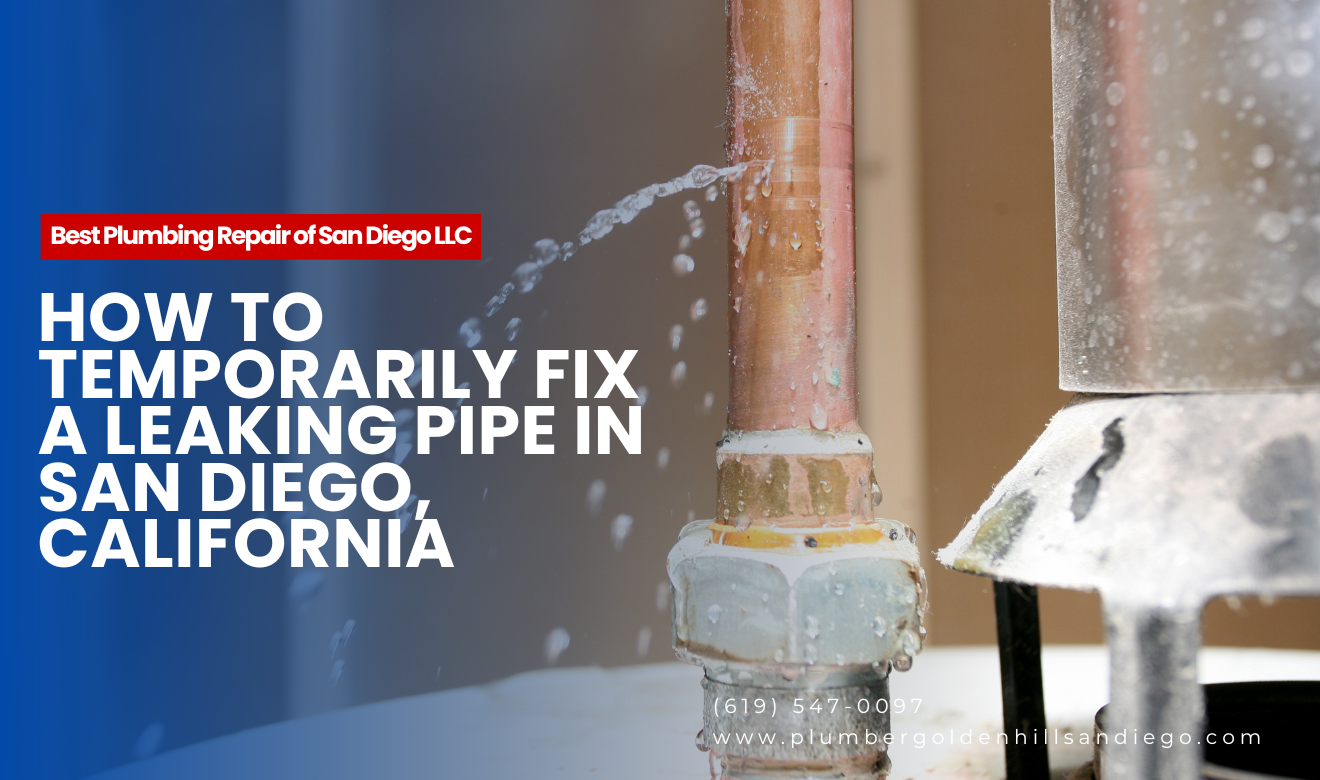
If a pipe leaks in San Diego, the priority is to quickly isolate the water source, reduce pressure, and contain moisture to prevent structural damage and mold. Temporary patches can limit damage, but recurring or hidden leaks require professional diagnosis and a code-compliant repair plan.
Key Takeaways
-
Shut off water first (fixture valve or main) — Stop the flow immediately and depressurize the system by opening a faucet to reduce spraying and flooding risk.
-
Identify supply vs. drain leaks — Supply leaks often run continuously and can flood fast, while drain leaks usually appear only when a fixture is used, guiding the safest next step.
-
Use proven temporary patch methods — Rubber-and-clamp wraps, epoxy putty, or minor compression-nut tightening can buy time, but duct tape and over-tightening often fail or worsen damage.
-
Control secondary damage quickly — Rapid drying, airflow, and water containment help prevent cabinet/floor swelling and reduce mold risk, which can begin within 24–48 hours in damp materials.
-
Escalate immediately for hidden leaks or electrical/water-heater proximity — Wall/ceiling/slab signs, water near outlets, or suspected sewer backups require prompt professional help for safe isolation and accurate leak pinpointing.
When a pipe starts leaking in San Diego, the fastest temporary fix is to shut off the water, relieve pressure, catch the drip, and patch the leak until a plumber can make a permanent repair. If you’re searching what to do when a pipe leaks San Diego, start by turning off the nearest shutoff valve under the sink or behind the toilet; if you can’t find one, shut off the main water valve. Then open a faucet for a minute to drain leftover water and reduce spraying.
Next, contain the water right away. Put a bucket under the leak, lay towels along the cabinet floor, and move anything that can get damaged—like cleaners, paper goods, or a vanity drawer full of toiletries. For a small pinhole leak, wrap the area tightly with rubber (like a piece of an old garden hose) and clamp it with a hose clamp or zip ties. For a cracked joint, press epoxy putty over the wet spot and smooth it around the pipe; it can buy you time even if the pipe is still damp.
If the leak is on a supply line, you can also snug the fitting slightly with a wrench—just a small turn to avoid stripping it. And if water is spreading toward outlets or under a water heater, keep the power area dry and avoid stepping in pooled water while you work.
What to do next when a pipe leaks in San Diego (after you’ve stopped the spray)
After the immediate steps in the introduction, the next priority is to prevent hidden damage and figure out where the leak is coming from. When people search what to do when a pipe leaks San Diego, they’re usually dealing with one of three situations:
- Visible leak under a sink, behind a toilet, at a water heater, or at a hose bib.
- Leak in a wall/ceiling (stains, bubbling paint, damp drywall, musty odor).
- Leak under the slab (unexplained high water bill, warm spots on floor, sound of running water).
Even “small” leaks aren’t small for long. The U.S. Environmental Protection Agency notes that household leaks can waste nearly 10,000 gallons of water per year, and 10% of homes have leaks that waste 90 gallons or more per day. That’s why knowing what to do when a pipe leaks San Diego matters: it protects your home and helps avoid avoidable costs.
How to tell what kind of pipe leak you’re dealing with
Use these quick identifiers to narrow down the source. This helps you choose the safest temporary fix and know how urgent professional repair is.
Supply line leak vs. drain leak (fast check)
- Supply line leak: leaks even when nothing is running; often sprays or drips steadily; water is clean/cold or clean/hot.
- Drain leak: shows up only when a sink/shower/toilet is used; may be slow; water may look dirty/soapy.
If you’re unsure what to do when a pipe leaks San Diego, treat it like a supply leak first (shut water off), because supply leaks can flood quickly.
Signs the leak is inside a wall or ceiling
- Paint bubbling, drywall swelling, or brown rings on ceilings
- Warped baseboards or flooring near bathrooms/kitchens
- Musty smell that doesn’t go away after cleaning
- Water meter continues moving when all fixtures are off
For a deeper walkthrough on tracking hidden moisture, see 5 tips to check for hidden plumbing leaks.
What to do when a pipe leaks San Diego and you can’t find a local shutoff
If there’s no fixture shutoff (or it’s stuck), use the main shutoff. In many San Diego homes, the main valve is:
- On an exterior wall near the front of the house, or
- In a ground box near the sidewalk/curb, or
- In a garage where the water line enters
Step-by-step: safer main shutoff procedure
- Turn off electricity to any area where water is pooling near outlets or devices (if safe to reach the panel).
- Close the main water valve clockwise (older gate valves may take multiple turns).
- Open the lowest faucet in the home (often a tub spout or outdoor hose bib) for 30–60 seconds.
- Flush toilets once to reduce tank supply water (avoid repeated flushes).
- Do not run hot water heavily if the water heater may be affected—especially gas units.
This is a practical baseline for what to do when a pipe leaks San Diego when you’re losing water fast.
How to patch a leaking pipe temporarily (materials that actually work)
Temporary repairs are about stopping water damage—not “fixing it forever.” Here are reliable stop-gap methods homeowners use until a plumber can replace or rebuild the failed section.
Best temporary fixes by leak type
| Leak type | Fast temporary fix | What to avoid |
|---|---|---|
| Pinhole in copper/metal pipe | Rubber patch + hose clamp; or repair tape rated for plumbing | Duct tape alone (fails quickly when wet/pressurized) |
| Crack at joint/fitting | Epoxy putty pressed firmly around joint; allow cure time | Over-tightening metal fittings (can worsen cracks) |
| Leaking compression nut (angle stop/supply) | Small wrench turn (1/8–1/4 turn); replace ferrule/nut if needed | Large turns (strips threads, crushes tubing) |
| Drain trap or slip-joint drip | Hand-tighten slip nuts; re-seat washer; replace trap washer | Putting sealant on threads (slip joints seal with washers) |
Keep in mind: if you’re repeatedly searching what to do when a pipe leaks San Diego for the same area, that’s a sign the pipe section is failing and needs a proper repair or repipe—not another patch.
Why pipes leak in San Diego homes (the common local causes)
San Diego’s housing stock ranges from older galvanized/copper systems to newer PEX. Leaks tend to cluster around a few predictable issues:
- Age-related corrosion in copper or galvanized lines (pinhole leaks, thin wall pipe).
- High water pressure stressing supply lines, valves, and water heater connections.
- Hard water mineral buildup contributing to valve wear and reduced flow (which can increase turbulence in spots).
- Improper or aging fittings at angle stops, flex connectors, and shutoff valves.
- Movement/vibration (water hammer) loosening joints over time.
If you suspect pressure is part of the problem, addressing it early can prevent repeat failures—one reason many homeowners looking up what to do when a pipe leaks San Diego later also end up dealing with regulators and supply protection.
How to protect your home from water damage while you wait for repair
Stopping the leak is step one. Limiting damage is step two.
Immediate water-damage control checklist
- Dry fast: fans + open cabinet doors; remove soaked items; blot then air-dry.
- Pull toe-kicks under kitchen cabinets if water ran behind them.
- Lift flooring edges (when possible) if water is trapped under vinyl or laminate.
- Watch for mold-friendly conditions: warmth + moisture + no airflow.
According to the U.S. EPA, mold can begin growing on damp materials within 24–48 hours under the right conditions. That’s why what to do when a pipe leaks San Diego isn’t only about plumbing—it’s also about drying and preventing secondary damage.
What to do when a pipe leaks San Diego and it’s near electrical or a water heater
Leaks around power sources raise the stakes. Use this approach:
- If water is near outlets/power strips: shut off the circuit at the panel if you can do so without stepping in water.
- If water is dripping onto a water heater: shut off the water supply to the heater; for electric units, turn off the breaker; for gas, avoid adjusting anything if you smell gas.
- If you smell gas: leave the area and contact your gas utility from outside; do not flip switches.
When people ask what to do when a pipe leaks San Diego in these scenarios, the safest answer always prioritizes electricity and gas awareness before cleanup.
Cost: what a leaking pipe can cost if you wait
The cost of a pipe leak varies wildly based on how long it ran and what it affected (cabinets, drywall, flooring, insulation). One widely cited national benchmark for homeowner insurance claims is from the Insurance Information Institute: water damage and freezing is among the most common causes of property damage in homeowners policies, and claim severity can be significant depending on the event. In practical terms, even a slow leak can lead to:
- Cabinet base swelling and delamination
- Drywall replacement and repainting
- Flooring removal due to trapped moisture
- Potential mold remediation if drying is delayed
This is exactly why acting quickly on what to do when a pipe leaks San Diego can save more than just water—it can save building materials.
How plumbers pinpoint the leak (and why that matters)
Once the immediate emergency is under control, the next step is diagnosis. Modern leak troubleshooting may include:
- Pressure testing to confirm a supply-side failure
- Moisture mapping to see how far water traveled
- Thermal imaging for hot-water line leaks beneath surfaces
- Video inspection for drain/sewer-related issues
When the issue involves drains or backups that mimic “leaks,” a professional Drain Cleaning service can be the fastest way to stop overflow at the source and prevent repeat water-on-floor incidents.
When a “pipe leak” is actually a drain or sewer problem
Many residents search what to do when a pipe leaks San Diego when the real issue is a drain backup that’s escaping at the weakest connection (like a slip joint) or overflowing from a shower/tub.
Clues it’s drainage (not pressurized supply)
- Leak happens only when the fixture is used
- Water is gray/brown or smells unpleasant
- Multiple fixtures are slow or gurgling
- Water appears around a floor drain
If multiple fixtures are involved, stop using water immediately and contain what you can—then move quickly, because backups can create sanitation risks.
Why high pressure keeps causing repeat leaks
If you’ve handled what to do when a pipe leaks San Diego more than once—especially with supply lines, angle stops, or water heater connections—check for pressure issues. Excess pressure can stress:
- Flexible supply connectors
- Shutoff valves
- Faucet cartridges and toilet fill valves
- Water heater components
A simple pressure gauge on a hose bib can provide a snapshot reading. Pressure can also spike at night in some neighborhoods. If pressure is consistently high, a pressure regulator may be needed to stabilize the system.
What to document for insurance or property management (quick and clean)
If the leak caused damage beyond a minor drip, document it while you’re doing what to do when a pipe leaks San Diego steps:
- Photo/video the leak source area (before and after shutoff)
- Photo/video any wet drywall, cabinets, or flooring
- Note the date/time you discovered it and what you did (shutoff, patch, drying)
- Save receipts for drying supplies or equipment rentals
Clear documentation speeds up decision-making and reduces back-and-forth if a claim or maintenance ticket becomes necessary.
Plumbing basics that help you make safer decisions
Understanding how residential plumbing systems work makes it easier to decide whether you should tighten a fitting, patch a pipe, or stop and call for help. In general:
- Pressurized lines (supply) can flood quickly and should be shut off first.
- Drain lines rely on gravity; leaks are often at joints, traps, or failed seals.
- Hot water lines expand/contract more, which can stress older joints over time.
These basics are a practical part of what to do when a pipe leaks San Diego because they guide your next move safely.
When to stop DIY and call a professional right away
Temporary patching is fine for a controlled drip. Stop DIY and get professional help promptly if:
- You can’t fully stop the water with a fixture shutoff or main valve
- The leak is in a wall, ceiling, or under the slab
- There’s visible corrosion across multiple sections of piping
- Water is near electrical components or a water heater
- You suspect a sewer/drain overflow rather than a clean-water leak
In these cases, what to do when a pipe leaks San Diego becomes less about patching and more about safe isolation, damage control, and accurate diagnosis.
Make the Fix Stick: the long-term plan after the leak stops
Once the immediate crisis passes, the goal is to prevent a repeat. A solid follow-up plan looks like this:
- Confirm the true source (not just where water shows up).
- Replace compromised parts (old angle stops, corroded sections, brittle connectors).
- Check pressure and correct it if it’s consistently high.
- Inspect nearby components—a leak often indicates similar wear elsewhere.
- Dry and monitor the area for several days for recurring moisture.
If you keep a simple “shutoff map” (main valve + fixture shutoffs) and a small leak kit (bucket, towels, hose clamp, rubber patch, epoxy putty), you’ll be ready the next time you need what to do when a pipe leaks San Diego guidance—hopefully as a precaution, not an emergency.
Built on Real-World Standards
The steps above reflect standard field practices used by licensed plumbers and restoration teams: isolate the water source, depressurize, contain, patch only as a short-term measure, and prioritize electrical safety and rapid drying to reduce the chance of mold growth. If you’re dealing with repeat leaks, hidden moisture, or pressure-related failures, the most reliable path is a properly diagnosed repair based on code-compliant methods and current best practices—so the next time you think about what to do when a pipe leaks San Diego, it’s for prevention instead of damage control.
Frequently Asked Questions
Stop the Leak Fast—Then Get It Fixed Right (Before It Comes Back)
You did the smart thing by shutting off the water and containing the mess—now don’t let a “temporary fix” turn into repeat damage, higher bills, or hidden mold behind the wall. If you’re dealing with a supply-line drip, a damp ceiling, or signs of a slab leak, Best Plumbing Repair of San Diego LLC can help pinpoint the source, stabilize the problem, and make a code-compliant repair that actually holds. The sooner you schedule a proper diagnosis, the easier (and cheaper) it is to protect your home from the next surprise leak.


