Key Takeaways
Most water pressure problems San Diego homeowners notice are usually traced to in-home causes rather than a citywide supply failure, and the most dependable way to stop guessing is to take a hose-bibb gauge reading and observe how pressure changes when fixtures run. Once you confirm whether the issue is fixture-specific or whole-house, you can match the fix to the cause—cleaning screens, verifying shutoffs, evaluating PRV behavior, checking for leaks, or addressing restrictive piping.
- Gauge-Based Diagnosis: A hose-bibb pressure gauge reading with no water running, followed by watching the pressure drop when a fixture runs, helps separate “low pressure” from “low flow” and narrows whether the problem is localized or whole-house.
- Whole-House Low Pressure Culprits: When all fixtures are weak, the most common causes described are a partially closed main shutoff, a failing or misadjusted PRV that can stick low or fluctuate, hidden leaks indicated by meter movement, or restricted/undersized piping (including older galvanized lines with internal corrosion).
- Localized Restrictions and Hot-Side Clues: If only one fixture is weak, the issue is often at the endpoint (a clogged aerator/showerhead screen, a partially closed angle stop, or a restricted cartridge), while hot-only weakness can point to the water heater shutoff, heat trap nipples, sediment, or a hot-side restriction.
Water pressure problems San Diego homeowners experience are most often caused by issues inside the home—such as failing pressure regulators (PRVs), mineral buildup in older galvanized piping, partially closed shutoff valves, or hidden leaks—rather than a citywide supply failure. Because water pressure is affected by elevation, a steep lot or hillside neighborhood can also see naturally lower pressure compared with lower-lying areas.
Consistently low pressure can make daily tasks difficult and may signal conditions that damage plumbing over time, including corrosion, sediment-restricted fixtures, or a regulator that’s stuck. Pressure that’s too high can be just as risky, stressing supply lines, water heaters, and appliance valves; accurate diagnosis starts with a simple gauge reading at a hose bibb and checking how pressure changes when fixtures run.
This guide covers the most common local causes, how to narrow down whether the problem is in the home or at the meter, and proven fixes—from cleaning aerators and showerheads to adjusting or replacing a PRV and identifying when a licensed plumber should test for leaks or piping restrictions.
How to Tell If Water Pressure Problems Start Inside Your Home or at the Meter
Before replacing parts, confirm whether your water pressure problems San Diego homeowners notice are limited to your plumbing system or coming from the supply side. A few simple checks can usually narrow it down in minutes.
Start by identifying whether the low pressure affects every fixture (whole-house issue) or only one or two faucets/showers (fixture-specific issue). Then compare readings at a hose bibb near the front of the home to what you experience inside.
- If only one fixture is weak: suspect an aerator, showerhead, angle stop valve, or the fixture’s cartridge.
- If hot water is weak but cold is fine: suspect the water heater shutoff, heat trap nipples, sediment, or a hot-side restriction.
- If every fixture is weak: suspect the main shutoff valve, pressure regulator (PRV), a hidden leak, or undersized/restricted piping.
- If pressure starts strong then quickly drops: suspect a clogged screen/filter, a failing PRV, or a partially closed valve.
Take a Baseline Pressure Reading (Quick and Reliable)
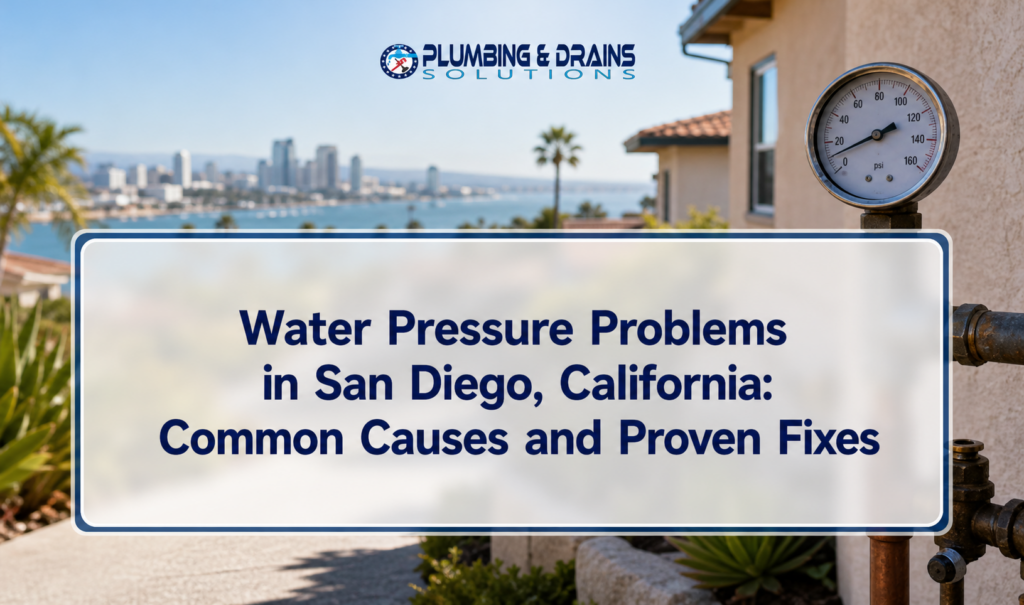
A simple hose-bibb pressure gauge is the fastest way to get objective data and avoid guessing. It also helps you tell “low pressure” from “low flow,” which are different problems.
- Confirm no water is running anywhere (dishwasher, laundry, irrigation, etc.).
- Screw a pressure gauge onto an outdoor hose bibb (ideally closest to where the main line enters the home).
- Open the bibb fully and record the reading.
- Turn on one fixture inside (like a tub spout) and watch how far the gauge drops.
- Little-to-no drop with a fixture running can suggest a localized restriction rather than a whole-house supply limitation.
- A large drop often points to a volume problem: restricted piping, a failing PRV, or a partially closed valve.
Most Common Causes of Low Water Pressure in San Diego Homes
San Diego’s housing stock includes older galvanized piping, hillside neighborhoods, and a mix of pressure regulators and valve types—all of which can contribute to low pressure. The most likely causes are usually inside the property boundary.
Partially Closed Main Shutoff or Meter Valve
A main valve that isn’t fully open can reduce volume to the entire home, often after recent plumbing work. This is one of the easiest issues to fix if accessible.
- Check the main shutoff inside/at the house (commonly near where the line enters).
- If you have a meter shutoff, only operate it if you know what you’re doing and have the proper tool; forcing it can cause damage.
- Confirm any secondary shutoffs (whole-house filters, softeners, or branch valves) are fully open.
Failing or Misadjusted Pressure Regulator (PRV)
A PRV reduces incoming pressure to a safe level, but when it fails it can “stick” low, fluctuate, or restrict volume. If your home has a PRV, it’s one of the first components to evaluate for whole-house low pressure.
- Symptoms of a PRV stuck low: all fixtures are weak, pressure doesn’t improve much at different times of day.
- Symptoms of an unstable PRV: pressure surges, then falls; shower temperature/flow fluctuates when other fixtures run.
- Common locations: near the main shutoff, at the riser coming up from the ground, or near the garage where the main line enters.
If testing indicates the regulator is the bottleneck, water pressure regulators service is typically the most direct path to accurate adjustment or replacement based on measured performance.
Mineral Scale and Corrosion in Older Piping
Older galvanized steel lines can corrode from the inside, reducing the pipe’s internal diameter and starving fixtures of flow. This often shows up as gradual decline over years rather than a sudden change.
- Common clues: rusty water at first draw, frequent aerator clogging, multiple fixtures worsening over time.
- Why it matters: restrictions create pressure loss under demand—so showers may feel “okay” until someone runs another fixture.
- Reality check: cleaning fixtures helps symptoms, but heavy internal corrosion may require repiping for a true fix.
Clogged Aerators, Showerheads, and Fixture Screens
When only one faucet or shower is weak, the fix is often at the fixture itself. Mineral particles and debris can clog the tiny passageways that shape the stream.
- Remove the aerator/showerhead.
- Rinse and inspect the screen for debris.
- Soak parts in vinegar to loosen mineral buildup, then scrub gently.
- Reinstall and retest.
- If pressure is still low, the issue may be the angle stop valve (under-sink shutoff) or the faucet/shower cartridge.
Hidden Leaks That Rob Pressure and Waste Water
A leak can reduce available flow and cause pressure drops during use, especially if the leak is significant or constant. Some leaks also create damage long before you notice a wet spot.
- Signs to watch: the sound of water when nothing is on, unexplained spikes in usage, warm spots on slab floors, or damp odors.
- Simple check: turn off all water and watch the meter; movement may indicate leakage (some meters have a small leak indicator).
For a practical checklist on early detection methods, see tips to check for hidden plumbing leaks.
High Water Pressure: The Overlooked Side of Water Pressure Problems
Pressure that’s too high can quietly damage fixtures, supply lines, and appliances—even if everything “seems fine.” If you see frequent leaks, banging pipes, or dripping valves, testing for excessive pressure is essential.
Many homes use PRVs specifically because incoming pressure can vary by neighborhood, elevation, and time of day. If a regulator fails open, pressure can rise beyond what household plumbing components tolerate well over time.
Common Symptoms of Excessive Pressure
High pressure doesn’t always feel “better”—it can create noisy, destructive conditions. It can also worsen small weaknesses into sudden failures.
- Water hammer (banging) when valves close quickly
- Frequent dripping from faucets, shower valves, or toilet fill valves
- Appliance hoses failing prematurely
- Unusual spikes on a pressure gauge when no water is running
Local Factors in San Diego That Can Affect Your Pressure
Some pressure variation is normal and not always “fixable” without changes to the home’s plumbing design. Understanding local conditions helps you choose the right improvement.
Elevation and Hillside Neighborhoods
Water pressure generally decreases as elevation increases, so homes on steep lots can experience naturally lower pressure than nearby lower-lying streets. In these situations, volume improvements (pipe sizing, restrictions, regulator performance) matter more than chasing an unrealistic pressure number.
Irrigation, Peak Demand, and Shared Supply Constraints
Pressure can dip during high-demand periods when many homes use water at the same time. If pressure is only low at certain hours but normal at others, that points away from fixture clogs and toward supply variability or a borderline restriction in your system.
Troubleshooting Checklist: What to Check (In Order) Before Replacing Anything
This step-by-step sequence prevents wasted time and unnecessary part swaps. Work from the easiest, most common causes toward the more involved ones.
- Confirm scope: one fixture, one side (hot/cold), or whole house?
- Check fixture screens: aerators, showerheads, inline screens.
- Verify shutoff positions: angle stops, main shutoff, any filtration valves.
- Gauge test at hose bibb: measure static pressure and observe pressure drop under flow.
- Look for leak indicators: meter movement when water is off, toilet flapper seepage, damp areas.
- Evaluate PRV behavior: stable vs fluctuating pressure, inability to adjust, sudden changes.
- Consider piping restrictions: older galvanized, heavy sediment, undersized branches.
Practical Fixes and When Each One Makes Sense
The right fix depends on whether your issue is pressure (force) or flow (volume), and whether it’s localized or whole-house. The options below map common symptoms to realistic solutions.
Cleaning or Replacing Fixture Components
If only a few fixtures are affected, start at the endpoints. This is low cost, low risk, and often solves the problem.
- Clean/replace aerators and showerheads
- Replace clogged faucet cartridges (if cleaning doesn’t restore flow)
- Confirm angle stop valves are fully open (and not broken internally)
Adjusting or Replacing a PRV
If the gauge reading is consistently low at the hose bibb and you have a PRV, adjustment may help—unless the regulator is failing. Replacement is typically needed when the regulator won’t hold a steady setting or restricts volume even when adjusted.
- Adjustment limitation: turning the screw may change pressure briefly but not resolve drops under demand if the valve is worn.
- Replacement indicators: pressure creep, unstable readings, inability to maintain set pressure, or internal blockage.
Finding and Repairing Leaks (Including Slab Leaks)
If the meter indicates a leak or you suspect water loss, leak location matters—walls, yards, or below slab require different approaches. Because leaks can mimic pressure loss and cause structural damage, early investigation is important when signs are present.
- Toilets can leak silently through the flapper and overflow tube.
- Yard service line leaks may show as soft soil, unexplained wet spots, or a hissing sound near the meter.
- Slab leaks may present as warm flooring, persistent damp smells, or cracks that worsen over time.
When symptoms point below the slab, slab leaks evaluation can help confirm whether pressure loss is being driven by an under-slab failure versus a restriction or regulator issue.
Addressing Restrictive Supply Lines and Valves
If pressure readings drop sharply when multiple fixtures run, the problem is often volume delivery—restricted pipe, undersized lines, or old valves that no longer open fully. These fixes are more involved but can provide the most noticeable improvement.
- Replace aging gate valves or failing ball valves that don’t open fully
- Evaluate old galvanized sections for internal corrosion and scale
- Check for partially obstructed flex connectors at fixtures and water heaters
Reference Table: What Your Symptoms Usually Point To
This comparison can help you decide whether to start at fixtures, the regulator, or leak detection. It’s not a substitute for testing, but it’s a practical way to prioritize the next step.
| Symptom / Observation | Most Likely Causes | Best Next Check |
|---|---|---|
| Only one faucet/shower has low flow | Clogged aerator/screen, cartridge issue, partially closed angle stop | Remove/clean aerator or showerhead; verify angle stop fully open |
| Whole house low pressure at all fixtures | Partially closed main valve, PRV stuck low, significant restriction | Gauge test at hose bibb; check main shutoff position and PRV location |
| Pressure fluctuates (surges/drops) when using water | Failing PRV, debris in regulator, intermittent restriction | Gauge test for stability; observe pressure while running a tub spout |
| Hot water pressure is low, cold is normal | Water heater valve partly closed, sediment/debris, hot-side restriction | Verify heater shutoff fully open; check fixture cartridges on hot side |
| Meter moves when all fixtures are off | Hidden leak (toilet, service line, slab, irrigation) | Isolate toilets/irrigation; repeat meter test; consider professional leak location |
When to Call a Licensed Plumber for Water Pressure Problems
Some pressure issues are straightforward DIY fixes, but others require tools, parts access, and experience to avoid damage or misdiagnosis. If you’ve completed basic checks and the issue persists, professional testing can save time and prevent repeat failures.
- You can’t locate the PRV or main shutoff, or valves won’t operate normally
- Pressure readings are unstable or unusually high/low despite adjustments
- You suspect a slab leak, yard leak, or in-wall leak but can’t confirm it
- Multiple fixtures have declining flow over time (possible pipe restriction)
- You’re seeing recurring leaks at supply lines, appliance connectors, or valves
Because plumbing systems are interconnected, “pressure problems” can involve supply, distribution, fixtures, and drainage interactions. A structured diagnostic approach—starting with gauge readings and isolation tests—is usually the quickest way to reach a durable fix.
Get to a Stable, Comfortable Pressure Without Guesswork
The most dependable path is to measure pressure, isolate whether the issue is localized or whole-house, and then match the fix to the cause—fixture restriction, valve position, PRV performance, leaks, or aging piping. With a few basic checks and the right next step, most water pressure problems San Diego homeowners deal with can be resolved without repeated repairs.
Frequently Asked Questions
Get Clear Answers on Your San Diego Water Pressure—With Testing, Not Guessing
If your showers have gone weak, fixtures fluctuate when another tap runs, or you’re worried pressure may be stressing your plumbing, a measured diagnosis can save time and prevent unnecessary part swaps. Checking readings at the hose bibb, verifying shutoffs, and evaluating PRV behavior helps pinpoint whether the issue is a simple fixture restriction or a whole-house volume problem.
When pressure is unstable, unusually high/low, or you suspect a hidden leak or restricted piping, professional evaluation can help isolate the cause safely and recommend the most practical next fix for your home.