
Executive Summary
Repiping replaces a home’s aging water supply lines to improve water pressure, reduce leaks, and stabilize water quality, with pricing in San Diego driven mostly by labor complexity and restoration needs. Comparing estimates accurately requires aligning scope details (fixtures, routing, testing, and patching) rather than judging by total price alone.
Key Takeaways
- Repiping scope is supply-side only: A whole-home repipe typically replaces domestic water supply lines to all fixtures and hose bibs, but it generally does not include drain/sewer replacement.
- Most repipes follow a predictable 1–3 day workflow: Planning and access cuts, running new lines, then pressure testing and patching are standard, though multi-story homes and limited access often extend timelines.
- Pricing is driven by access and restoration as much as plumbing: Home layout, fixture count, crawlspace/attic conditions, and patching expectations (rough patch vs. paint-ready) are major factors behind repiping services pricing in San Diego.
- PEX vs. copper affects both cost and performance: PEX usually installs faster with fewer in-wall joints, while copper has a long track record but often comes with higher material and labor costs.
- Best estimate comparisons are scope-based, not price-based: Itemized bids that specify fixture coverage, shutoff strategy, routing plan, pressure testing, permits, and warranty terms reduce surprises and make pricing comparisons fair.
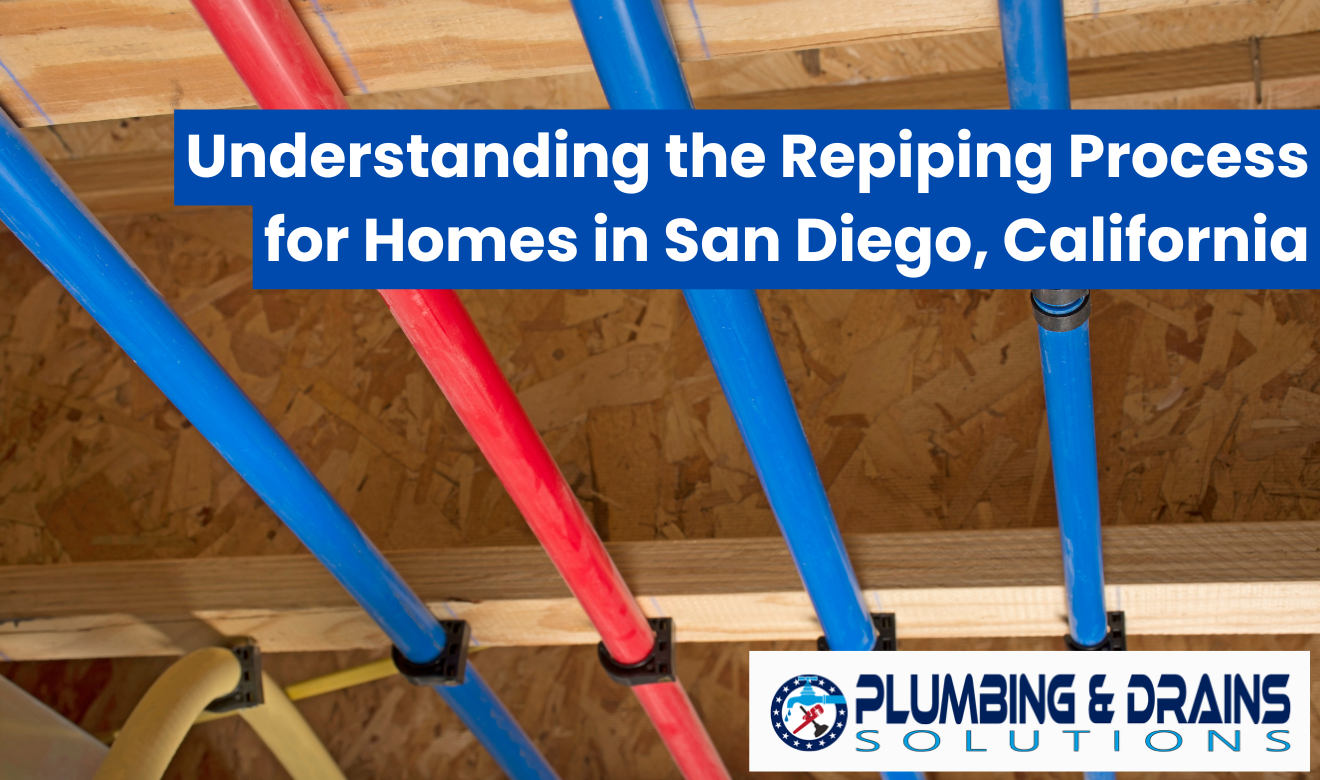
Repiping a home in San Diego, California means replacing old or failing water supply pipes so you get steady water pressure, cleaner water, and fewer leaks. If you’re comparing repiping services pricing San Diego, the total usually depends on your home’s size, pipe material, and how accessible the plumbing is.
For example, if you’re seeing rusty water in the morning, hearing banging pipes when you turn off the shower, or dealing with repeated slab leaks, repiping can solve the root issue instead of patching the same problem again. In a typical single-story home, crews may run new lines through the attic and walls, then restore small access points afterward. In a two-story home or a house with tight crawl spaces, the work can take longer because routing new piping is more complicated.
This guide walks you through what the repiping process looks like in San Diego, what to expect day by day, and the key factors that influence cost, timeline, and disruption.
What repiping includes in a typical San Diego home
When homeowners compare repiping services pricing San Diego, it helps to know what “repiping” actually covers. In most cases, a whole-home repipe replaces the domestic water supply piping that feeds:
- Kitchen sink, dishwasher, refrigerator line
- Bathroom sinks, toilets, showers/tubs
- Laundry hookups
- Water heater connections
- Hose bibs/outdoor spigots
Repiping usually does not include drain/sewer replacement (that’s a different system). However, many homes discover both supply and drain issues around the same time—especially if the house is older or has a history of leaks, corrosion, or recurring stoppages.
If you want a quick definition of how the systems work together, it’s worth understanding the basics of plumbing so you can separate supply-pipe problems from drain-line problems when comparing bids and timelines.
How the repiping process works (day-by-day)
Most homeowners searching repiping services pricing San Diego also want a realistic picture of disruption. While every house is different, a standard repipe often follows a predictable sequence.
Day 1: Planning, protection, and access points
- Confirm fixture count and pipe routing plan (attic, crawlspace, or walls).
- Protect floors and work areas; mark access points.
- Shut down water and begin opening small sections of drywall/stucco as needed.
Day 2: Running new water lines
- Install new hot/cold trunk lines and branch lines to fixtures.
- Set new shutoffs where appropriate (many owners request fixture shutoffs if missing).
- Transition connections at water heater and main line as required by code and layout.
Day 3: Pressure testing and put-back
- Pressure test for leaks and verify flow at fixtures.
- Restore water and confirm hot water delivery, pressure balance, and noise reduction.
- Patch openings (often “rough patch”; texture/paint matching may be separate depending on the scope).
Timeline note: A smaller, single-story home may be completed in 1–3 days. Larger homes, multi-story layouts, or limited access can extend the timeline. This is one reason repiping services pricing San Diego can vary widely even for homes with similar square footage.
Cost: What drives repiping services pricing San Diego
In San Diego, repipe costs tend to swing based on labor complexity and how much routing/repair work is required—not just the pipe itself. The biggest pricing drivers include:
- Home layout: Single-story homes with attic access are often simpler than two-story homes with finished ceilings.
- Number of fixtures: More bathrooms, outdoor spigots, and specialty lines (fridges, pot fillers) add labor and materials.
- Accessibility: Tight crawlspaces, vaulted ceilings, tile-heavy walls, and limited attic clearance increase labor time.
- Material choice: PEX vs. copper affects both material cost and installation approach.
- Patch/repair expectations: “Access + rough patch” is different from paint-ready restoration.
- Permits/inspections: Local requirements can affect scheduling and documentation.
- Condition of the main line and shutoff: If the main shutoff is outdated or the pressure is excessive, additional work may be recommended.
When you request bids, ask for an itemized scope so you can compare repiping services pricing San Diego on an apples-to-apples basis. The lowest number can be misleading if it excludes patching, fixture shutoffs, or necessary tie-ins.
Quick comparison table: common price-impact factors
| factor | why it changes pricing | what to ask in your estimate |
|---|---|---|
| two-story vs. one-story | more vertical runs, more wall/ceiling access work | routing plan and number/location of access points |
| PEX vs. copper | material cost, installation time, and fitting strategy differ | brand/type of piping, warranty terms, and connection method |
| crawlspace/attic access | restricted access increases labor time and patching | how crews will run mains/branches and protect the home |
| patching + finish work | restoration scope can be a major variable | whether patching is rough-only or paint/texture-ready |
If you’re doing deep research on repiping services pricing San Diego, keep this in mind: the “real” cost is often the combination of plumbing work plus the access and restoration strategy required by your home’s construction.
What pipe material should you choose in San Diego?
Material selection is a core part of repiping services pricing San Diego because it influences labor, fittings, and long-term performance.
PEX (cross-linked polyethylene)
- Pros: Flexible routing (fewer joints in walls), fast installation, good corrosion resistance.
- Cons: UV sensitive (can’t be left exposed to sunlight), quality depends on correct fittings and installation.
Copper (Type L commonly used for residential supply)
- Pros: Long track record, heat tolerant, rigid runs can be neat and durable when installed correctly.
- Cons: Typically higher material cost; more joints; corrosion risk can increase depending on water chemistry and pipe age/history.
San Diego homes vary widely by era and build style, so a reputable estimate should include a clear rationale for material selection—not just a default option. This is also why comparing repiping services pricing San Diego without comparing material specs can lead to confusion.
Why homeowners repipe instead of repairing leak after leak
Repairs can make sense for isolated issues. But once leaks repeat, homeowners often shift from “patching” to “solving.” Common tipping points include:
- Multiple pinhole leaks over time
- Recurring slab leaks or damp flooring
- Rust-colored water or metallic taste/odor
- Pressure drops when multiple fixtures run
- Water hammer or pipe-banging symptoms that persist after basic fixes
For leak-related symptoms, it can help to review practical warning signs and next steps in slab leak detection in San Diego. Many homeowners start there, then realize a repipe may be the most cost-effective long-term option once repeated repairs add up.
How to prepare your home (and your schedule) for repiping
Good prep reduces stress and can even reduce labor time—important when weighing repiping services pricing San Diego.
Before work begins
- Clear access: Move stored items from under sinks, around water heater, and in garage/crawl access areas.
- Plan for water shutoffs: Expect periods without water during tie-ins and testing.
- Protect valuables: Crews typically protect surfaces, but it’s smart to remove fragile items from shelves near work walls.
- Confirm restoration scope: Know exactly what patching is included.
During the repipe
- Keep pets secured away from work zones.
- Ask where temporary water access will be (if provided).
- Do a quick end-of-day walkthrough to confirm what’s completed and what’s next.
What to expect after repiping: pressure, noise, and water quality
Homeowners typically notice improvements quickly, but a few items are normal during the transition:
- Short-term air in lines: Brief sputtering at faucets is common after a shutoff.
- Cleaner aerators: It’s smart to clean faucet aerators/showerheads after work.
- More stable pressure: Especially if old galvanized lines were restricting flow.
- Reduced leak risk: A major reason people accept repiping services pricing San Diego as a long-term investment rather than a quick fix.
If pressure is still unusually high or inconsistent after a repipe, it may be time to evaluate the pressure control side of the system. In many homes, a failing regulator contributes to stress on piping and fixtures. If needed, consider water pressure regulators service to help protect the new lines.
How to compare repiping estimates (without getting burned)
To evaluate repiping services pricing San Diego fairly, compare scope and standards—not just the total price. A solid repipe estimate usually answers:
- Which fixtures are included? Count them—don’t assume.
- What material and grade? Specify PEX type or copper type (and fitting method).
- What is the routing plan? Attic drops vs. crawlspace runs vs. in-wall paths.
- How many shutoffs will be installed? Whole-home shutoff, fixture shutoffs, hose bib shutoffs.
- How will the home be patched? Rough patch vs. paint-ready.
- Will there be a pressure test? Confirm test method and documentation if available.
- What warranty is provided? Ask what’s covered (materials, workmanship, exclusions).
These questions help you compare repiping services pricing San Diego based on outcomes and risk reduction—what you actually care about—rather than a number that may exclude key items.
Real-world indicators from reputable sources (why repiping matters)
Two widely cited realities underscore why repiping isn’t just cosmetic:
- Pipe corrosion and scale reduce flow over time: Older steel/galvanized piping can accumulate internal buildup that narrows the effective diameter, which contributes to low pressure and uneven flow.
- Small leaks can waste surprising amounts of water: The U.S. Environmental Protection Agency (EPA) notes that household leaks can waste nearly 10,000 gallons of water per year, and that common leaks are often easy to fix when caught early. When leaks become recurring due to aging piping, replacement may be the more durable path than repeated spot repairs.
That’s why many homeowners viewing repiping services pricing San Diego as “expensive” change their perspective after adding up water damage risk, repeated service calls, and lost time dealing with the same failure mode.
When repiping is urgent vs. when you can plan it
Not every situation requires immediate demolition and replacement. Use this as a quick guide while assessing repiping services pricing San Diego and timing.
Repiping is often urgent when:
- You’ve had multiple leaks in a short period
- There’s evidence of a slab leak (warm spots, unexplained water bills, damp flooring)
- Water quality shows persistent rust discoloration
- Insurance or restoration teams document active water damage from supply lines
You can often plan repiping when:
- You have aging pipes but only occasional symptoms
- You’re remodeling bathrooms/kitchen and want to update supply lines at the same time
- You’re proactively upgrading before listing the home
Planning ahead can also help control repiping services pricing San Diego because you can schedule during normal business hours and coordinate with painters or remodelers for smoother restoration.
Common mistakes that increase repiping cost and disruption
Homeowners can unintentionally drive up repiping services pricing San Diego by overlooking a few basics:
- Not clarifying patching: “We patch” can mean anything from a temporary cover to a paint-ready finish.
- Skipping pressure control: High pressure can shorten the life of fixtures and stress joints.
- Ignoring shutoff strategy: A good valve layout prevents future emergencies from turning into whole-home shutoffs.
- Focusing only on pipe choice: Routing and access strategy often matter more than the pipe itself.
Addressing these items upfront usually results in a cleaner project, fewer change orders, and a more accurate comparison of repiping services pricing San Diego.
“Peace-of-mind plumbing” starts with the right scope
Repiping isn’t just replacing pipe—it’s redesigning reliability into your home’s water delivery. If you’re evaluating repiping services pricing San Diego, the best results come from clear scope, verified testing, and code-aligned installation methods that reduce hidden leak risk.
Look for teams that can explain routing choices, provide transparent material specs, and document pressure testing and shutoff placement. The most trustworthy pros typically have:
- State-licensed plumbing credentials appropriate for California work
- Demonstrated experience with whole-home repipes (single-story, two-story, crawlspace, and slab scenarios)
- Familiarity with permitting/inspection workflows and best practices for protecting finished surfaces
- A written warranty covering workmanship and materials (with clear exclusions)
With those pieces in place, comparing repiping services pricing San Diego becomes straightforward—and you can choose based on long-term performance, not short-term patchwork.
Frequently Asked Questions
Stop Guessing on Repiping Costs—Get a Clear, Same‑Day Game Plan
If you’re weighing repiping services pricing in San Diego, the fastest way to cut through the noise is to get an on-site assessment that looks at your layout, fixture count, access points, and the right material for your home—so you’re not comparing “mystery bids” that leave out patching, shutoffs, or key tie-ins. Best Plumbing Repair of San Diego LLC can walk you through the repipe process, explain your options (PEX vs. copper), and give you a straight, itemized estimate you can actually trust—so you can fix the root problem and move on with your life.


